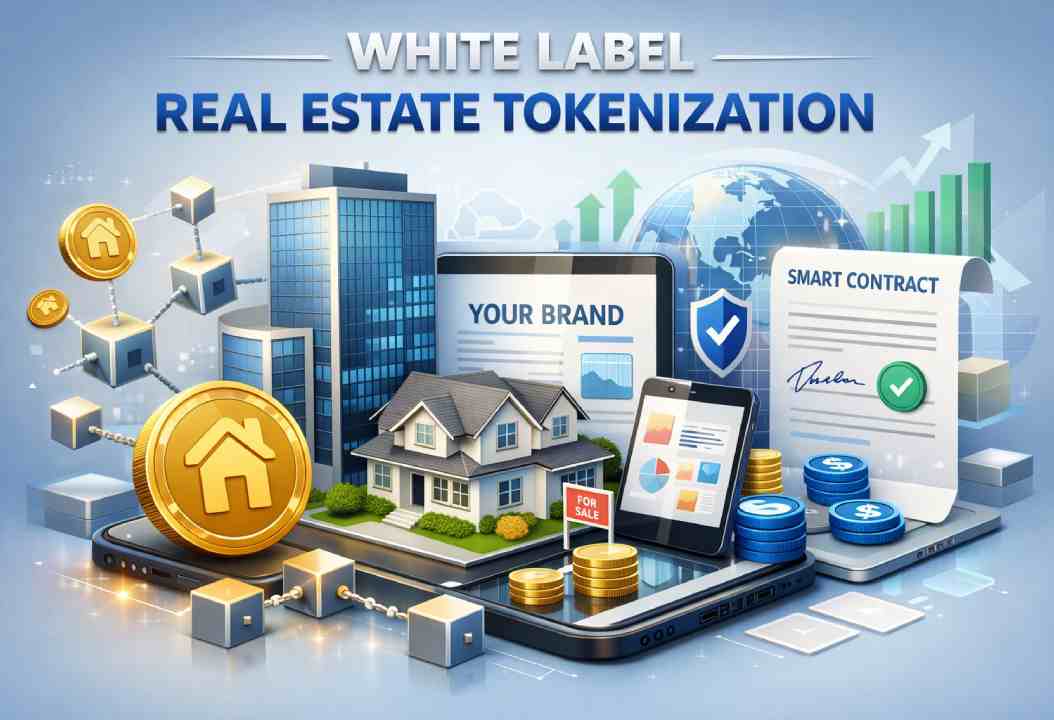
Launching a real estate tokenization solution from scratch is a complex process involving blockchain development, legal structuring, compliance integration, security audits, and user experience design. A white label real estate tokenization platform simplifies this journey by providing a ready-made, customizable infrastructure that can be quickly deployed under a company’s brand. This significantly reduces development time, operational complexity, and time-to-market, enabling faster entry into the tokenized real estate ecosystem.
Understanding White Label Real Estate Tokenization Platforms
A white label real estate tokenization platform is a pre-built software solution that enables businesses to tokenize real estate assets without building the underlying technology from the ground up. These platforms include modules for token issuance, investor onboarding, compliance management, asset tracking, and secondary trading.
They are often built on blockchain networks such as Ethereum, which support smart contracts and token standards, or scalable networks like Polygon that reduce transaction costs and improve efficiency.
By using a white label solution, companies can focus on business strategy, asset acquisition, and investor engagement while the platform handles the technical backbone.
1. Eliminating the Need for Ground-Up Development
Building a white label real estate tokenization platform from scratch requires extensive resources, including blockchain engineers, UI/UX designers, compliance experts, and security specialists. This process can take months or even years.
White label platforms eliminate this need by offering a ready-to-use infrastructure. Businesses can simply configure the platform, customize the interface, and launch operations quickly.
This drastically reduces development cycles and allows companies to enter the market faster without compromising on functionality or quality.
2. Pre-Built Smart Contract Frameworks
Smart contracts are essential for managing tokenized real estate assets, as they define ownership rights, automate transactions, and ensure transparency.
White label platforms come with pre-audited smart contract templates that can be easily customized for different asset types. These contracts handle functions such as:
- Token issuance and distribution
- Rental income or profit sharing
- Ownership transfers
- Governance and voting
By using these pre-built frameworks, companies avoid the time-consuming process of writing and auditing smart contracts from scratch, accelerating deployment while maintaining security.
3. Integrated Compliance and Regulatory Tools
Compliance is one of the biggest challenges in real estate tokenization. Regulations such as Know Your Customer (KYC), Anti-Money Laundering (AML), and investor accreditation must be followed strictly.
White label platforms include built-in compliance modules that automate these processes. These systems verify investor identities, enforce jurisdictional restrictions, and ensure adherence to legal frameworks.
By integrating compliance into the platform, businesses can launch faster without needing to build separate regulatory systems. This reduces legal complexity and speeds up investor onboarding.
4. Streamlined Investor Onboarding
Investor onboarding is a critical step in launching a tokenized real estate platform. White label solutions simplify this process by providing intuitive user interfaces and automated onboarding workflows.
Investors can quickly register, complete KYC verification, connect their wallets, and begin investing in tokenized assets. This reduces friction and ensures a smooth user experience.
The faster and easier the onboarding process, the quicker a platform can attract and activate users, contributing to rapid market entry.
5. Built-In Wallet and Payment Integrations
White label platforms often include integrated digital wallets and payment gateways, allowing users to securely store and transfer tokens.
These integrations eliminate the need to build wallet infrastructure from scratch and support seamless transactions. Investors can purchase tokens, receive distributions, and trade assets without leaving the platform.
By simplifying financial interactions, these integrations contribute to faster deployment and improved usability.
6. Secondary Market and Liquidity Features
Liquidity is essential for attracting investors to tokenized real estate. White label platforms often include secondary market functionality or integration with external exchanges such as Uniswap.
This allows investors to trade tokens after issuance, providing liquidity and flexibility. Having built-in trading capabilities from day one makes the platform more attractive and reduces the need for additional development.
This feature significantly accelerates market readiness by ensuring that assets are not only issued but also tradable immediately.
7. Custom Branding and UI/UX Flexibility
One of the key advantages of white label platforms is the ability to fully customize branding and user experience. Businesses can apply their own logo, color schemes, and interface design, making the platform appear as a proprietary solution.
This reduces the time required to design and develop a user interface from scratch while still delivering a professional and branded experience.
A strong UI/UX enhances user trust and engagement, which is critical when launching a new financial platform.
8. Reduced Costs and Resource Requirements
Developing a tokenization platform internally requires significant financial investment. Costs include hiring developers, conducting audits, implementing compliance systems, and maintaining infrastructure.
White label platforms significantly reduce these costs by providing a ready-made solution. Businesses can allocate resources toward marketing, partnerships, and asset acquisition instead of technical development.
Lower costs combined with faster deployment make white label platforms an ideal choice for startups and enterprises entering the tokenization space.
9. Security and Pre-Audited Infrastructure
Security is a top priority in real estate tokenization, as platforms handle valuable assets and sensitive investor data. White label platforms come with built-in security features, including encryption, multi-signature wallets, and audit trails.
Many platforms also provide pre-audited smart contracts, reducing the risk of vulnerabilities and ensuring a secure environment for transactions.
This eliminates the need for lengthy security audits during development, further accelerating the launch process.
10. Scalability and Future-Ready Architecture
White label platforms are designed to scale as the business grows. Whether tokenizing a single property or managing a large portfolio of assets, these platforms can handle increasing transaction volumes and user activity.
They are also built with interoperability in mind, allowing integration with multiple blockchain networks and external systems. This ensures that businesses can expand their offerings without needing to rebuild their infrastructure.
Scalability ensures that the platform remains efficient and effective as demand increases.
11. Faster Market Testing and Iteration
White label platforms enable businesses to quickly test new ideas and strategies in the market. Since the core infrastructure is already in place, companies can experiment with different token models, pricing strategies, and asset types.
This allows for rapid iteration and optimization based on user feedback. Faster testing cycles lead to quicker improvements and better product-market fit.
Conclusion
A white label real estate tokenization platform plays a crucial role in accelerating the launch of tokenized asset solutions. By providing pre-built infrastructure, smart contract frameworks, compliance tools, and integrated trading capabilities, these platforms eliminate the need for extensive development and reduce time-to-market.
They enable businesses to focus on strategic growth while leveraging secure, scalable, and customizable technology. With features such as built-in compliance, liquidity integration, and user-friendly interfaces, white label platforms offer a streamlined pathway to entering the real estate tokenization market.
As the demand for digital assets continues to grow, white label solutions will remain a key enabler for organizations looking to launch efficient, compliant, and scalable tokenization platforms quickly and effectively.