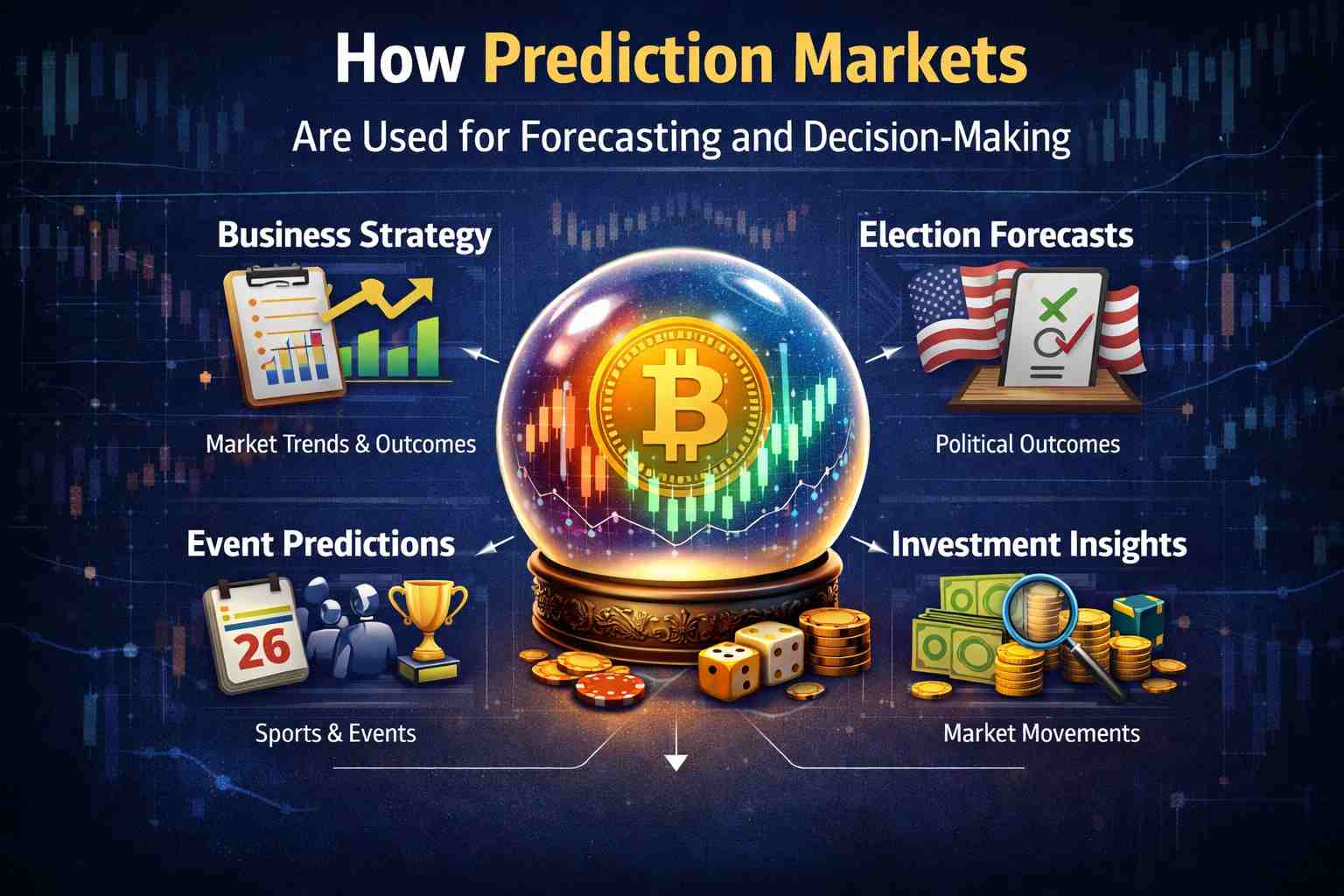
Prediction markets are trading systems built around questions about future events. Instead of buying a stock or bond, participants buy and sell contracts tied to outcomes such as an election result, a product launch date, a sales target, or whether a policy change will occur. Prices move as traders incorporate new information, and those prices are commonly interpreted as real-time probabilities. The Iowa Electronic Markets, one of the longest-running academic examples, describes itself as an online futures market where contract payoffs depend on real-world events such as political outcomes and company earnings. That definition captures the broader logic of the field: prediction markets turn beliefs about the future into tradable signals.
What makes prediction markets distinctive is not just that they forecast. Many tools forecast. Surveys, expert panels, econometric models, and machine learning systems all do that. Prediction markets are different because they attach incentives to being right. Google Cloud’s explanation of its internal prediction market put the core idea plainly: by incentivizing the right people to forecast accurately, a market can produce a consensus forecast that is more accurate than any individual. That mechanism matters for decision-making because it does more than collect opinions. It forces participants to update their views when evidence changes and rewards them, at least in principle, for better judgment rather than louder confidence.
This is why prediction markets are used both for public forecasting and for organizational decisions. In public settings, they are used to estimate the likelihood of elections, policy outcomes, economic indicators, sports results, and other uncertain events. In private settings, companies have used them to forecast sales, launch timing, and project outcomes. The Commodity Futures Trading Commission has recently described prediction markets, or event contracts, as instruments that can help market participants hedge risk, aggregate information, and provide the public with information about future outcomes. That is a useful framework because it shows prediction markets as more than speculation. They are also information systems.
Why prediction markets often forecast well
The strongest case for prediction markets comes from their track record in aggregating dispersed information. Academic work on the Iowa Electronic Markets found that market forecasts were closer to eventual U.S. presidential vote outcomes than 964 contemporaneous polls in 74% of comparisons across elections from 1988 onward, with especially strong performance at longer forecasting horizons. Other Iowa research found election-eve prediction errors as low as about 1.34 percentage points on average for U.S. presidential markets, which is impressive given the inherent uncertainty of elections. These results do not mean markets are always right, but they do show why decision-makers pay attention to them: prices can condense a broad range of private and public information into a single, continuously updated estimate.
The reason this works is structural. In a conventional forecasting meeting, people may hold different information but share it imperfectly. Some speak first and anchor the discussion. Some defer to seniority. Some hide doubts. A market changes the format. Participants can express beliefs anonymously through trades, and prices adjust as information enters the system. The mechanism is especially useful when relevant knowledge is fragmented across many people rather than concentrated in one forecasting team. That is why prediction markets have often been described as a form of information aggregation rather than merely a betting interface. Google Cloud’s internal case makes this especially clear: some questions, such as macroeconomic shifts or complex business outcomes, require drawing on knowledge scattered across an organization, and a market can help combine those judgments more efficiently than a standard meeting.
How organizations use prediction markets internally
Corporate use cases reveal the decision-making value of prediction markets better than headline political markets do. Research on internal markets at Google, Ford, and another large firm found that these markets were relatively efficient and improved on expert forecasts by as much as a 25% reduction in mean-squared error. That is a significant result because corporate environments are often less favorable to markets than public ones: participation can be limited, incentives can be weaker, and employees may have biases or strategic reasons to shade their views. Even in that setting, the markets still produced useful forecasts.
Google has been one of the best-known examples. Its first internal market ran from 2005 to 2007, and a newer effort was launched in 2020 during the uncertainty of the pandemic. Google Cloud’s later write-up explained that the system was designed to forecast questions that mattered to the company by letting employees trade on outcomes and thereby produce a consensus estimate. The importance of that example is not just technical. It shows how prediction markets can be used inside large organizations to complement planning, identify hidden disagreement, and force a more explicit treatment of uncertainty. Managers often ask what will happen. Markets push them to ask what probability they should assign to what might happen.
Earlier corporate research also points in the same direction. The literature repeatedly cites Hewlett-Packard’s internal sales-forecasting markets as outperforming traditional corporate forecasting methods in many cases. That matters because sales forecasting is a classic decision problem with direct operational consequences. Better forecasts influence inventory planning, staffing, procurement, and capital allocation. When a market does better than a standard internal process, it suggests that the organization’s information was always there, but the usual structure was failing to aggregate it effectively.
In practical terms, companies use prediction markets for questions such as whether a product will launch on time, whether quarterly targets will be met, whether demand will exceed plan, or whether a policy initiative will succeed. These are not theoretical exercises. They support decisions about inventory, marketing spend, staffing, risk management, and executive expectations. A well-designed prediction market development workflow therefore has less to do with novelty than with selecting questions that matter, aligning incentives, and making sure the forecasts actually reach decision-makers rather than sitting in an isolated dashboard.
Public prediction markets and real-time forecasting
Public prediction markets show a different but related value. They can act as live barometers of collective expectations around politics, economics, and public events. The Iowa Electronic Markets have done this for decades in research settings. More recently, platforms such as Kalshi and Polymarket have brought prediction markets back into mainstream discussion. Polymarket’s 2024 U.S. election pages showed hundreds of millions of dollars in market volume, while Kalshi and Polymarket were both prominent enough in 2026 Oscar forecasting that major financial media compared how many winners they called correctly. That level of activity matters because higher participation can improve information aggregation by drawing in more viewpoints and more informed traders.
Public markets are especially useful when people need a probability, not just a narrative. Polls can show who is ahead. Expert commentary can explain why. But a market price can answer a different question: what is the current implied chance of a specific outcome, given what traders collectively know and believe right now? That can be valuable for journalists, analysts, investors, and policy observers who need a continuously updated signal rather than a weekly survey snapshot. The CFTC has emphasized that event contracts can provide the public with information about future outcomes, and that is one reason regulators and market participants take them seriously even when they disagree about specific contracts.
How prediction markets improve decision-making
The direct forecasting benefit is only part of the story. Prediction markets can improve decision-making by changing how uncertainty is discussed inside an organization or around a public issue. First, they create explicit probabilities. A price of 0.70 is a clearer signal than a manager saying she feels “pretty confident.” Second, they update continuously as new information arrives. Third, they reveal where confidence is weak. A market stuck near 0.52 says something very different from one trading at 0.90. That difference helps decision-makers distinguish between a likely outcome and a coin flip dressed up in confident language.
Prediction markets also help expose disagreement that might be hidden in formal planning processes. In many organizations, the official forecast reflects hierarchy as much as evidence. Internal markets can surface whether employees across functions believe the stated target is realistic. They can also reveal who updates quickly when new evidence appears. Research on Google’s markets documented biases such as optimism, but also found that inefficiencies tended to shrink over time as participants gained experience. That is important because it suggests markets can become better decision tools as the user base learns how to use them.
Another advantage is that markets can be paired with other forecasting tools rather than replacing them. Econometric models are useful when history is rich and stable. Expert judgment is useful when context matters. Prediction markets add value when key information is dispersed and difficult to summarize in a single model. Google Cloud explicitly framed internal markets as complementary to machine learning and forecasting systems, especially for questions where judgment and organization-wide knowledge matter. For many businesses, the real win is not replacing existing systems but combining them. A statistical forecast may generate the baseline; a market may capture what the model misses.
Limits that decision-makers still need to respect
Prediction markets are useful, but they are not magic. Thin participation can reduce reliability. Poorly written questions produce noisy signals. Internal company markets may suffer from weak incentives, strategic behavior, or fear of signaling dissent. Public markets can face manipulation attempts, legal constraints, and uneven liquidity. The corporate literature is clear that firms have been slower to adopt prediction markets precisely because organizational settings introduce problems such as thinness and weak incentives. These are manageable issues, but they matter.
Regulation is another major limit in public markets. In the United States, the legal treatment of event contracts remains contested, and the issue has become more visible in 2025 and 2026 as the CFTC, states, and platforms such as Kalshi and Polymarket have argued over jurisdiction and permissible markets. That uncertainty affects how broadly prediction markets can be used, especially in areas close to gambling, elections, and sports. A capable prediction market development company therefore needs to think not only about interface and smart contracts, but also about contract design, settlement, compliance, and jurisdictional constraints.
Why they matter now
Prediction markets matter because they offer a disciplined way to turn uncertainty into actionable signals. In business, they can help forecast demand, launch timing, and target attainment. In public life, they can help observers track changing expectations around elections, policies, and macro events. In both settings, their strongest contribution is not certainty. It is calibration. They force participants and decision-makers to express uncertainty numerically and update those beliefs when evidence changes. That is a valuable discipline in any environment where overconfidence and vague language can distort choices. A mature set of Prediction market development services is therefore best understood as decision-support infrastructure, not just as a marketplace feature.
Conclusion
Prediction markets are used for forecasting and decision-making because they aggregate dispersed information, attach incentives to accuracy, and produce continuously updated probabilities about uncertain events. Research from the Iowa Electronic Markets, corporate studies involving Google and Ford, and modern public platforms all point to the same underlying strength: markets can sometimes outperform polls, expert panels, and traditional internal forecasting methods when the relevant knowledge is spread across many people. Their value is greatest when leaders need a real probability, a sharper view of disagreement, or a live signal that updates as conditions change. They are not flawless, and they require careful design, enough participation, and regulatory awareness. But when used well, prediction markets help organizations and observers move from guesswork and vague confidence to a more disciplined, evidence-sensitive way of thinking about the future.