ICO vs IDO vs IEO: How Token Development Strategy Changes for Each
Token fundraising has evolved rapidly as blockchain projects explore different models to raise capital and build communities. ICO, IDO, and IEO are three major fundraising approaches that define how tokens are created, distributed, and introduced to investors. Each model follows a distinct structure, influencing everything from token design to marketing execution and compliance requirements. Choosing the right approach is not just about preference; it directly impacts how a project gains trust, attracts users, and scales in the competitive Web3 ecosystem. This is where professional Token Development Services play a crucial role in aligning technical architecture with fundraising strategy.
What is an ICO?
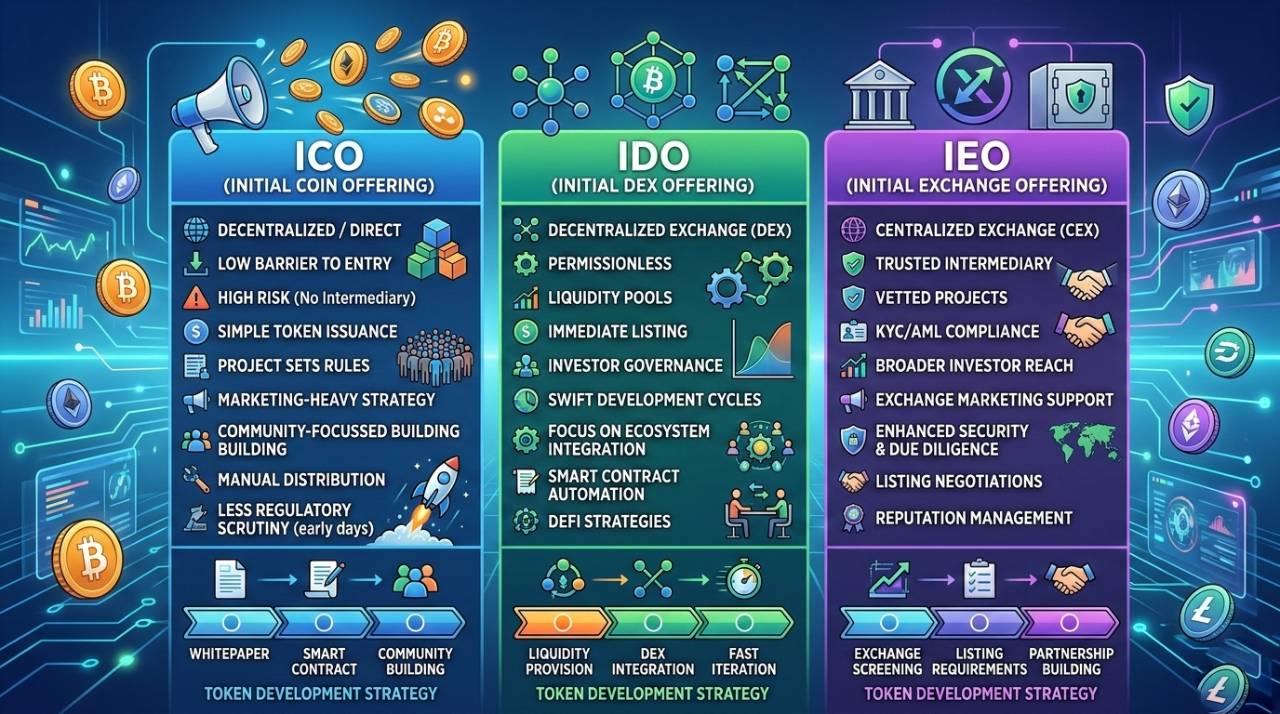
Initial Coin Offering is one of the earliest and most flexible methods of raising funds in the blockchain space. In an ICO, the project team sells tokens directly to investors through its own platform, without relying on a centralized exchange. This gives full control over token creation, pricing, distribution, and fundraising structure. Projects can define their own rules, including soft caps, hard caps, and vesting schedules. ICOs are often preferred by startups that want complete ownership over their fundraising process and branding. However, this flexibility also brings challenges such as regulatory concerns, trust issues, and the need for strong marketing to attract investors.
What is an IDO?
Initial DEX Offering is a decentralized fundraising model conducted on decentralized exchanges. In an IDO, tokens are launched directly on platforms like automated market makers, allowing instant liquidity and trading. This model removes intermediaries and promotes transparency, as smart contracts handle the entire process. IDOs are known for their speed, accessibility, and community-driven nature. They also enable projects to reach a wider audience without heavy listing requirements. However, they demand a well-planned token structure to handle liquidity pools, price volatility, and fair distribution.
What is an IEO?
Initial Exchange Offering is conducted through centralized exchanges that act as intermediaries between the project and investors. In an IEO, the exchange manages token sales, performs due diligence, and promotes the project to its user base. This model offers higher credibility because investors trust the exchange’s verification process. It also simplifies fundraising for projects, as the exchange handles technical and marketing aspects. However, IEOs involve strict listing criteria, higher costs, and less control over token distribution compared to ICOs and IDOs.
Token Development Strategy in ICO
In ICO-based fundraising, the token development strategy focuses heavily on customization and flexibility. Since there is no intermediary, the project team must design tokens that align with its business model and investor expectations. Tokenomics plays a central role, including supply allocation, pricing tiers, and vesting mechanisms. Smart contract development must ensure secure token creation, distribution, and fundraising management. Security audits are essential to build investor confidence. Additionally, the token must support various payment methods, allowing investors to participate using multiple cryptocurrencies. Marketing integration is also critical, as the success of an ICO depends on strong community engagement and visibility.
Token Development Strategy in IDO
For IDOs, the token development strategy shifts toward liquidity and decentralization. Tokens must be designed to integrate seamlessly with decentralized exchanges and liquidity pools. This involves creating mechanisms for automated pricing, slippage control, and fair launch distribution. The focus is on ensuring that tokens can be traded immediately after launch without technical issues. Developers must also consider anti-bot measures and fair allocation systems to prevent manipulation during the launch phase. Since IDOs rely heavily on community participation, token design often includes incentives such as staking rewards and governance features. Efficient Token Development Services help projects build tokens that are optimized for decentralized ecosystems while maintaining security and scalability.
Token Development Strategy in IEO
In IEOs, token development strategy is influenced by exchange requirements and compliance standards. Tokens must meet specific technical and regulatory criteria set by the hosting exchange. This includes compatibility with the exchange’s infrastructure, security standards, and user interface. Tokenomics must align with investor expectations while adhering to exchange guidelines. Vesting schedules, distribution mechanisms, and utility features are often predefined or reviewed by the exchange. Projects also need to focus on transparency and documentation, as exchanges conduct thorough evaluations before listing tokens. The development process becomes more structured, ensuring that the token is ready for large-scale adoption and trading.
Key Differences in Token Development Approach
The differences between ICO, IDO, and IEO become more evident when comparing their token development approaches. ICOs prioritize flexibility, allowing projects to experiment with innovative token models and fundraising structures. IDOs emphasize decentralization and liquidity, requiring tokens to function efficiently in automated trading environments. IEOs focus on compliance and credibility, ensuring tokens meet strict exchange standards. These differences affect how tokens are designed, deployed, and managed. Projects must carefully evaluate their goals, target audience, and resources before choosing a fundraising model.
Security and Compliance Considerations
Security is a critical factor across all three models, but the approach varies significantly. In ICOs, the responsibility lies entirely with the project team, making smart contract audits and secure infrastructure essential. IDOs rely on decentralized protocols, which require robust coding practices to prevent vulnerabilities in liquidity pools and trading mechanisms. IEOs benefit from the exchange’s security measures, but projects must still ensure their tokens meet required standards. Compliance also differs, with ICOs facing the most regulatory uncertainty, while IEOs operate within more structured frameworks. Token Development Services help navigate these challenges by ensuring tokens are secure, compliant, and aligned with industry best practices.
Marketing and Community Impact
The choice of fundraising model directly influences marketing strategy and community engagement. ICOs require extensive marketing efforts to build trust and attract investors independently. IDOs benefit from community-driven hype and decentralized participation, making social engagement a key factor. IEOs leverage the exchange’s existing user base, reducing the need for aggressive marketing but requiring strong branding to stand out. Token design also plays a role in community engagement, with features like staking, rewards, and governance encouraging long-term participation.
Cost and Time Implications
Each model has different cost structures and timelines. ICOs are relatively cost-effective but require significant investment in marketing and development. IDOs are faster to launch and involve lower listing costs, but require careful planning to manage liquidity and trading dynamics. IEOs are more expensive due to exchange fees and compliance requirements, but they offer higher credibility and exposure. The development timeline also varies, with ICOs allowing more flexibility, while IEOs follow strict schedules set by exchanges.
Choosing the Right Token Development Strategy
Selecting the right fundraising model depends on multiple factors, including project goals, target audience, budget, and technical capabilities. ICOs are suitable for projects seeking full control and customization. IDOs are ideal for those focusing on decentralization and rapid market entry. IEOs work best for projects that prioritize credibility and access to a large investor base. A well-defined token development strategy ensures that the chosen model aligns with the project’s vision and market expectations.
Conclusion
ICO, IDO, and IEO each offer unique advantages and challenges, shaping how tokens are developed and launched. The choice of model influences every aspect of token creation, from technical design to marketing execution and compliance. Projects must carefully evaluate their objectives and resources to determine the most suitable approach. With the support of expert Token Development Services, businesses can create robust, scalable, and investor-ready tokens that align with their fundraising strategy and long-term growth goals.